
By Justin Mercer, Cammihouse Technical Team.
1. Accommodation Units: The 165-Container Requirement
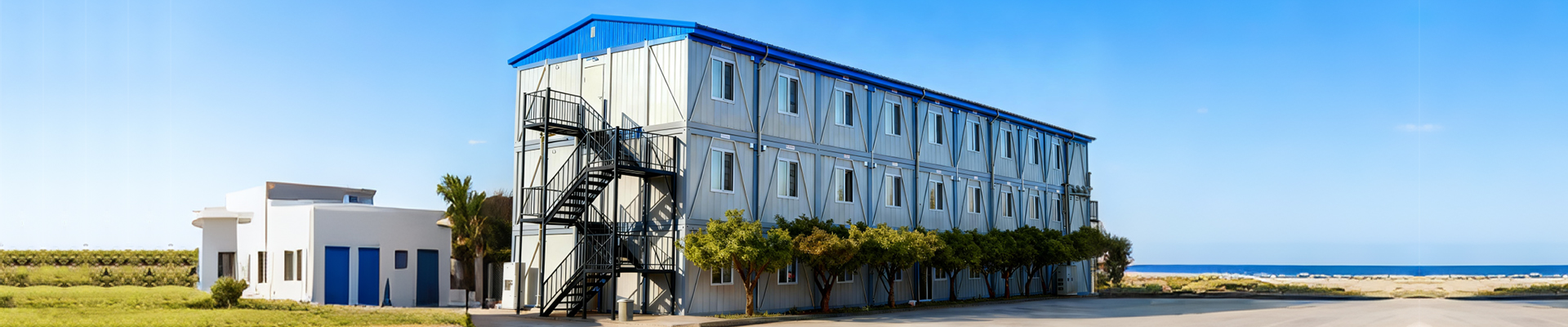
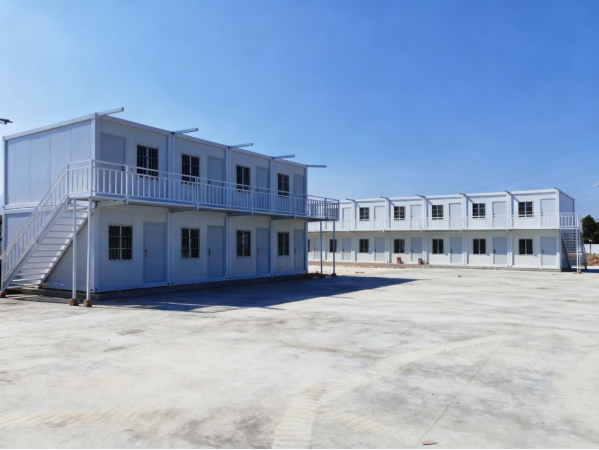
A 500-person mining camp requires approximately 165 standard 20ft units to meet the 4.0 m² per person minimum floor area recommended by the International Finance Corporation (IFC 2009).
Standard worker housing typically accommodates four persons per unit. To ensure retention of senior talent, management quarters are usually single-occupancy. In a 2024 Cammihouse technical audit, a modular container home configuration with a 4:1 worker-to-manager ratio was identified as most efficient for site density.
Sleeping quarters and density ratios
Calculating density is critical for social distancing and ventilation; over-populated units increase health risks, potentially halting production.
2. Dining and Kitchen: A 35-Unit Culinary Hub
For a 500-person camp, a 35-unit dining facility is necessary to accommodate a 250-seat canteen operating in overlapping shifts.
A 20ft container provides roughly 14.8 m² of area. For 500 staff, 25 units create the dining hall, while 10 units house an industrial kitchen. McKinsey (2019) research highlights that modular kitchen setups can be deployed 40% faster than traditional builds.
Sanitary standards in food preparation
Integrated grease traps and stainless-steel cladding are non-negotiable for meeting HACCP hygiene standards in remote mining environments.
3. Administrative Center: 6 Units for Site Operations
The administrative heart of the camp requires 6 units to house IT infrastructure, HR offices, and security monitoring.
A custom container house approach for the office allows open-plan layouts through wall removal. According to MBI (2022), modular offices allow 20% footprint expansion without disrupting site operations.
Connectivity and IT server integration
Dedicated climate control for server racks within the admin module ensures critical satellite communications remain operational in desert heat.
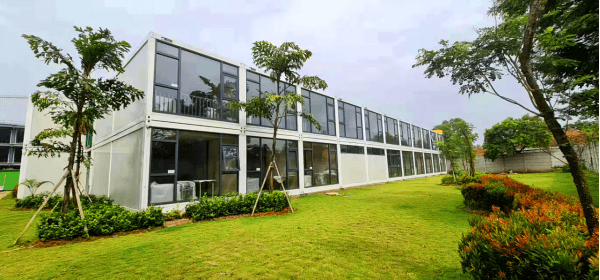
4. Medical Clinic: 4 Units for WHO Compliance
A dedicated 4-unit clinic is the minimum requirement to provide primary care and a 2-bed isolation ward for a 500-person workforce.
WHO guidelines for remote sites emphasize sterile environments separated from living quarters. In remote projects, Cammihouse medical modules use HEPA filtration to maintain surgical-grade air quality during dust storms.
Emergency response and triage
Proximity to the camp gate and integrated ambulance docking bays are essential design features for rapid medevac procedures.
5. Recreation and Gym: 10 Units for Mental Well-being
Providing 10 units for recreation—including a gym and lounge—is essential for mitigating camp fatigue during 3-week FIFO rotations.
A minimalist container house aesthetic for the lounge reduces the feeling of confinement. Surveys show camps with robust recreation see a 15% increase in staff retention.
Designing for staff retention
Multi-functional spaces that serve as training rooms by day and cinemas by night maximize the return on recreational investment.
6. Laundry and Ablution: 8 Units for Hygiene
An 8-unit central laundry and ablution block is required to process roughly 1,500 kg of linen and workwear per week.
To maintain IFC standards, one shower should be provided for every 8 workers. By utilizing high-efficiency fixtures, a prefab container house laundry block can reduce site water consumption by 25%.
Water usage and greywater management
Integrated plumbing manifolds in laundry modules allow rapid connection to water treatment plants, reducing environmental impact.
7. Storage and Utility: 10 Units for Power and Parts
The camp requires 10 units for critical spare parts storage, electrical switchgear, and backup power generators.
A shipping container home for a 500kVA generator must be sound-proofed to 75dB. Using containers for storage also protects electrical components from iron ore dust.
Microgrid integration
Flat roofs provide over 3,000 m² of surface area for solar mounting, supporting hybrid power systems in remote locations.
8. Site Layout: The 20% Space Buffer
Effective site planning requires a 20% physical buffer between modules for fire safety and adequate light penetration.
ASCE recommends specific fire-break distances. Modern layouts use 'U' or 'H' patterns to create wind corridors. Cammihouse surveys show sites following these rules report 10% lower cooling costs.
Fire safety and emergency egress
Clear signage and 3-meter wide walkways between blocks are mandatory for meeting international life safety codes like NFPA 101.
FAQ
Q: Can you handle both Metric and Imperial measurement systems for customization?
A: Yes. We use professional CAD and Revit software that supports both systems to ensure seamless integration with your local architectural plans.
Q: My projects range from Middle East heat to Arctic cold. What are your insulation solutions?
A: We offer varied thicknesses of PU/Rockwool panels. For the Middle East, we use heat-reflective coatings; for cold regions, we provide Triple-Glazed windows and cold-bridge-free designs.
Q: Q: How do you optimize the loading to reduce the cost per square meter of shipping?
A: We use "Flat-Pack" or "Knock-Down" shipping methods for larger villas, allowing us to fit more living space into one 40HQ, significantly reducing the global landed cost.
